
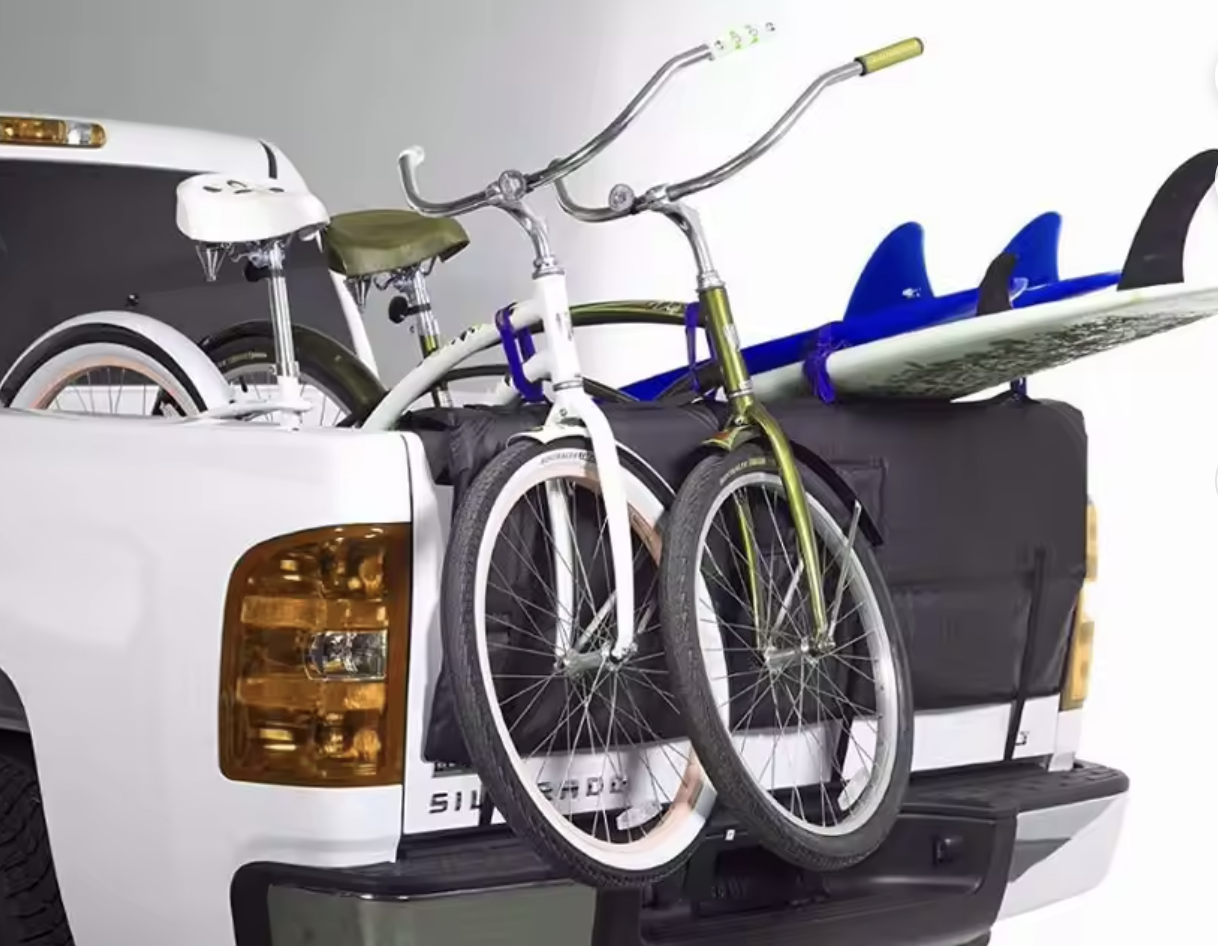
Pickup trucks are beloved for their versatility, making them the go-to choice for outdoor enthusiasts, handymen, and anyone needing to haul large or bulky items. Whether you’re heading to the trail with 3-5 bicycles, transporting a ladder to a job site, or loading a kayak for a day on the water, proper loading techniques are crucial to ensure safety, protect your cargo, and prevent damage to your truck. One essential accessory that simplifies safe loading and safeguards your vehicle is our tailgate protective pad—a must-have for every pickup owner looking to make hauling hassle-free and secure.

First, let’s address transporting 3-5 bicycles, a common need for families or cycling groups. The key to safe bike transport is stability and protection: loose bicycles can shift during transit, scratching your truck or even falling out. Start by positioning the bikes in the truck bed with their wheels facing the same direction, ideally angled slightly to maximize space. Avoid stacking bikes directly on top of each other, as this can cause scratches on frames or components. This is where our tailgate protective pad shines. Crafted from durable, thick neoprene material, it forms a protective barrier between the bicycles and your truck’s tailgate, preventing scratches, dents, and paint chips caused by metal frames or handlebars rubbing against the surface. What’s more, the pad features multiple reinforced tie-down points specifically designed for securing bicycles. Use high-quality straps to fasten each bike’s frame to these fixed points—this keeps the bikes upright and immobile, even on bumpy roads. For 3-5 bikes, distribute their weight evenly across the bed to maintain balanced handling, and always ensure the tailgate is fully closed and latched before driving.

When transporting ladders, safety and stability are non-negotiable, as an unsecured ladder can become a dangerous projectile. First, choose the right ladder length for your truck bed: if the ladder extends beyond the tailgate, you’ll need a red flag or reflector attached to the overhanging end (check local regulations for length limits). Place the ladder in the bed with its weight centered, and rest the top end against the cab (using a cab protector if available) to prevent it from shifting forward. Our tailgate protective pad plays a vital role here too. By covering the tailgate, it protects the ladder’s rails from scratches and also prevents the ladder from damaging the tailgate’s edge. The pad’s built-in fixed points are perfect for securing the ladder’s lower end—use ratchet straps to fasten the ladder tightly to these points, ensuring there’s no side-to-side or up-and-down movement. Never rely solely on the tailgate to hold the ladder; the combination of the protective pad’s fixed points and sturdy straps ensures maximum security.
Hauling a kayak requires careful handling to avoid damaging the watercraft and your truck. Kayaks are large, lightweight, and prone to sliding, so proper securing is essential. First, place a non-slip mat in the truck bed to prevent the kayak from shifting (our tailgate pad complements this by protecting the tailgate where the kayak may rest). If the kayak fits entirely in the bed, center it and use straps to fasten it to the tailgate pad’s fixed points—one strap at the front near the cab and one at the rear by the tailgate. If the kayak extends beyond the tailgate, attach a flag or reflector to the end. The tailgate protective pad’s thick material cushions the kayak’s hull, preventing scratches and dents that can occur during loading and transit. Additionally, the pad’s tie-down points are strong enough to withstand the tension needed to keep the kayak secure, even at highway speeds. Avoid over-tightening the straps, as this can damage the kayak’s hull; aim for firm tension that keeps the kayak immobile without crushing the material.
Beyond these specific loading tips, there are general best practices for all cargo: always check strap tightness before driving and after every 50 miles, avoid overloading your truck (refer to your vehicle’s payload capacity), and drive at a moderate speed, especially when hauling bulky items. Our tailgate protective pad is designed to be a versatile solution for all these hauling needs—it’s easy to install (simply slip it over the tailgate and secure with built-in straps) and fits most standard pickup tailgates. It’s not just a protective accessory; it’s a safety enhancer that simplifies securing your cargo, saving you time and giving you peace of mind.
Transporting bicycles, ladders, or kayaks in your pickup truck should be a straightforward, stress-free experience. By following these correct loading methods and equipping your truck with our tailgate protective pad—with its unbeatable protection against scratches and purpose-built fixed points for secure tying—you can keep your vehicle, your cargo, and other road users safe. Whether you’re an outdoor adventurer or a professional handyman, this accessory is an investment that pays off in durability, convenience, and safety. So, before your next haul, make sure your pickup is equipped with our tailgate protective pad—your truck and your cargo will thank you.
How to Mout Tailgate Pad on Pickup to Load Bikes?
STEP 1:Feed Straps
Lay the Basecamp Pad over the open tailgate and feed all the straps into the tailgate gap.
STEP 2: Hook Em’
1. Hook the straps around the G-hooks & lock
2. Feed the locking strap up through the gap
STEP 3: Adjust Straps
Adjust all straps on the back of the Basecamp Pad so the straps are taut. No need to go very tight. This bad boy ain’t going anywhere.
STEP 4: Setting The Lock
Open the carabiner lock and set the combo to 000. THIS IS THE FACTORY SET DEFAULT CODE.
STEP 5: Grab Your Pen
Use the included pen to push-in the recessed pin inside the lock. ONLY PUSH IN PIN, NOT THE ENTIRE MECHANISM.
STEP 6: Almost There
With the pin pushed-in, select your combo one digit at a time. TEST AFTER EACH DIGIT. DO NOT DO EVERY DIGIT AT ONCE.